
Decoding Government Decision-Making: The Karnataka bike taxi ban case

Much has already been written and said about the recent bike taxi ban in Karnataka and its repercussions.
Here I attempt to use this case as the backdrop to dig into two broader questions:
What might incentivise governments to enforce such a ban and to refuse to create a regulatory framework?
What economic, cultural or societal issues does this relate to, and what can be done towards better outcomes?
First, a bit of context about the ban, its impact and stated reasons drawing from an opinion piece by Professor Anupam Manur of the The Takshashila Institution.
The Ban and Its Impact
Professor Manur’s article states that the ban is “counterproductive” – it removes credible options from the solution architecture addressing the urban mobility challenge, especially for last-mile connectivity. The ban also eliminates an efficient mode of navigation through traffic snarls critical for a city like Bengaluru.
The scale of impact is significant: Nearly 8 crore trips in a year and nearly 1,00,000 bike taxi operators who are on these platforms that will be left without a means of earning1. The ban leaves commuters reliant on costlier autorickshaws and cabs, which often overcharge or refuse short rides. In addition, estimates suggest that the ban could cost the exchequer several dozens of crores in GST2.
During the Karnataka High Court hearing on June 13th, the Advocate General representing the state informed the court that the government has explicitly decided against framing specific regulations for bike taxis3.
This follows a pattern of similar ideas that were removed in Bengaluru previously - shared autos, private busses, shared taxis on apps, and carpooling for profit.
Stated Reasons leading to the Ban
The piece attributes the ban to:
Vested interests of lobbies and special interest groups such as auto unions. Government prioritising these unions over commuter needs and innovation.
Lack of initiative on the part of the government, despite guidelines being already available from the Union government and other states (MH, Goa).
Lack of consideration for the larger public welfare.
Concerns about safety.
While all of these hold weight, it still makes me wonder what leads Governments to make such decisions and whether there might be more to it.
The Thomas Sowell Insight: Politicians as Rational Actors
At around the same time that I read these articles, a quote popped up on my X feed:
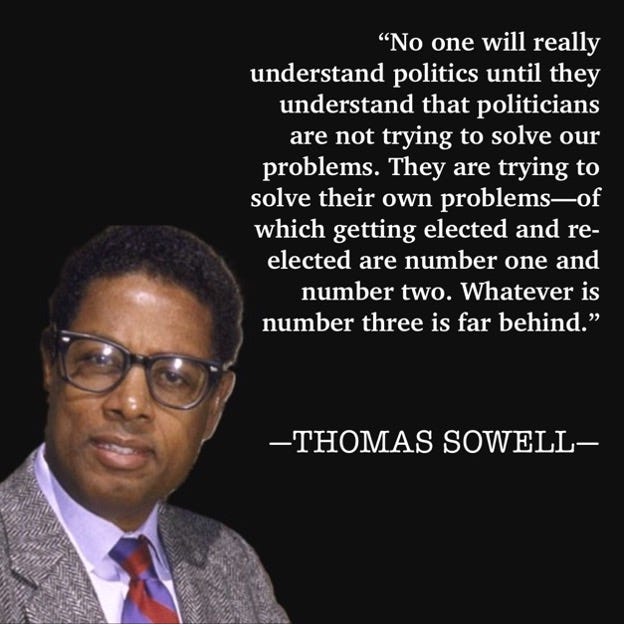
This insight from Thomas Sowell, a prominent American economist and senior fellow at the Hoover Institution, got me thinking that politicians and government decision makers are also just individuals shaped by incentives. Given that scarcity of resources means that only some of the people can be satisfied and that too only some of the times - at the margin, any steps politicians take will be driven by what they believe will make them more popular and at the very least not make them less popular with other groups. This applies regardless of any lobbying pressures.
However, given that the ban appears unpopular among gig workers and commuters, yet was still implemented, lets explore some other factors that might influence such decision making.
Cultural and Societal Factors
Public Transport as Government Domain
In large parts of India, providing for public transport is generally seen as a government responsibility and not a private concern. Due to historical reasons4, this seems like an accepted societal belief that underpins many decisions. I suspect it is one of the reasons we have yellow boards to distinguish cabs as opposed to other western nations where no such labelling is at play. Contrast this with several US states or Europe where general citizens may find it culturally and procedurally easier to sign up & comply as an Uber driver5 and offer up a short Uber trip or two in their private cars whenever they want. In India, the very word “public” transport could be playing into strengthening the belief that transport is fundamentally a “public sector” domain.
This may also be associated with safety, security, privacy and quality concerns. In addition, stories from places like Delhi that might have had bad experiences with privatisation6 of public transport in the past stick more in public memory and are greater discussion points, than some distant European city that actually made it work.
Trust and Safety Concerns
We live in a society with low societal trust in public safety especially when it comes to getting on a bike with a stranger7. Being in close proximity of the driver leads to concerns over harassment or at least a general lack of comfort level. In addition, over-speeding and rash driving risks are presumably higher than with a four wheeler especially, when road space is tight and traffic is erratic.
All of this is further exacerbated by the lack of effectiveness of regulation & enforcement in general and consequently a lack of belief in such measures being effective at all.
How would these be factored into the marginal cost of actually implementing policies towards bike taxis?
Challenges in addressing the costs
Cultural Beliefs and Electoral Calculus
One of the challenges could be just pessimism - the lack of belief that things can be any better! This absolves the government to some extent. Citizens need to believe in the possibilities of equalling or exceeding what is typically thought of as “foreign" quality”.
Another inherent challenge in a democracy would be the marginalisation of the minority - If only a low percentage of the population is affected or only a specific constituency – especially one that doesn't matter as much from an electoral perspective - then what of that section? Where does the bike taxi consumer fall on this spectrum?
State Capacity and Alternative Considerations
Then there is the question of whether the state has sufficient capacity to implement and enforce policies around vehicle and rider safety. The government’s reluctance to draft, implement and enforce regulation despite the existence of central guidelines8 brings this question sharply into focus. In addition, there is wide ground of public opinion to be prepared than is first apparent. There is also opportunity cost - whether the capacity is better invested elsewhere to improve the traffic situation or mass public transport.
Even if the government did bring regulation and privatisation of bike transport, consider private players’ innovative approaches to bypass rules9 and regulators typically playing a catch up game with private players. Naturally, citizens come to accept that only so much quality and security can be expected.
Considerations and Way Forward
More Competition and Worker protection: Sufficient competition, collusion prevention, and interests of gig workers -- all of these need to come into play to ensure that private players are sufficiently incentivised to ensure higher levels of service and safety.
Increasing Supply versus Decreasing Congestion: The broader goal may be more than just higher supply of transport vehicles or faster commute around traffic jams. It maybe that we wish to eliminate (or reduce) jams altogether and permitting too many more vehicles may act as a deterrent.
Unit Efficiency - consider Driver to Passengers Ratio: In lieu, more efficient solutions are needed to address public transport and traffic woes. This means favouring high quality and efficient mass transport options over bikes that only transport one person at a time. In terms of fuel cost and added vehicles on the road, the difference could be stark. Examples could include shared cabs, car pooling and private busses - reasons for previous failures need to be examined and reworked.
Positive Sum Game, Level Playing Field and Adjusted Taxation: At the same time, consensus is needed among the government, the civil society and unions that this is definitely not a zero sum game. However, given that autos and cabs are taxed annually, there is a need to create a level playing field through a potentially separate registration of white board vehicles, or downward adjustments in the burdensome yellow-board taxes/fees (with minimal or no loss of revenue) and simpler regulation of both types of vehicles. The growing population in a city like Bengaluru and the growing number of vehicles each year indicates that the pie of people needing transport is definitely growing - boding well for state finances as well.
Social Norms & Culture over Regulation: Finally, regulatory frameworks can be a poor cousin to superior culture and societal norms. Effective cultures may be driven by societal disincentives for non-compliance and implicit market incentives for superior service & compliance. Some of this could be addressed by easier to use safety reporting apps by either government or aggregators, campaigns to improve awareness of such apps and greater transparency from aggregators for handling safety and vehicle quality violations.
Yet…
the way out of Bengaluru’s traffic and transport woes always seems out of reach! There remains much to be uncovered on how we can nudge public opinion and government decisions in a favourable direction. What one new step can we take in the direction of better decision making that weighs broader public costs & needs alongside immediate pressures?
Footnotes:
View are personal and do not represent the stand of any organisation.
This post was copy-edited using Anthropic Claude towards organising the content better into sections, grammatical corrections, some section title suggestions and better transitional phrases between paragraphs or sections. No concepts nor analysis were introduced by Claude.
https://www.hindustantimes.com/cities/bengaluru-news/ola-uber-rapido-bike-taxis-banned-in-karnataka-starting-today-not-a-side-income-this-is-how-we-survive-say-driver-101750040127628.html
https://www.goodreturns.in/news/bike-taxi-ban-rapido-uber-ola-services-to-halt-in-karnataka-from-16-june-know-the-reasons-here-1435913.html
https://lawchakra.in/high-court/ban-on-bike-taxis-operations/
http://www.liiofindia.org/in/legis/cen/num_act/rtca1950338/ . Note - the Road Transport Corporations Act 1950 permitted state governments to establish a Road Transport Corporation and if it did, then it would be the “duty” of the Corporation to provide adequate and economical road transport services. This led to ubiquitous government bus services at scale with vast coverage, creating a perception of a public service.
https://www.uber.com/us/en/drive/requirements/ and https://avidlawyers.com/blog/vehicle-and-driver-requirements-for-uber-and-lyft-in-florida/ as an example
https://www.hindustantimes.com/delhi/blueline-s-20-year-killer-run-comes-to-a-close/story-E7MR5UQq8kRaoBXoQgLj7L.html
https://www.deccanherald.com/india/karnataka/bengaluru/are-bike-taxis-safe-for-women-1213612.html
https://timesofindia.indiatimes.com/business/india-business/taxi-permits-to-two-wheelers-by-states-legal-govt/articleshow/67075642.cms in conjunction with https://www.pib.gov.in/Pressreleaseshare.aspx?PRID=1676403
https://timesofindia.indiatimes.com/city/bengaluru/rides-paused-rules-twisted-rtos-in-bengaluru-go-undercover-as-bike-parcel-becomes-cover-for-banned-taxi-services-crackdown-begins/articleshow/121897016.cms